
Content Marketing Strategies: A Complete Guide for 2026
Content marketing has become one of the most effective ways for businesses to attract customers, build trust, and grow their online presence. Instead of directly asking people to buy a product or service, content marketing focuses on providing useful and valuable information that helps an audience solve problems and make better decisions.
Whether you are a small business owner, digital marketer, freelancer, blogger, or large company, having the right content marketing strategies can help you reach the right audience and turn visitors into loyal customers.
In today’s competitive digital environment, simply creating content is not enough. Businesses need to understand what their audience wants, create high-quality content, optimize it for search engines, and distribute it through the right channels.
This guide explains the most effective content marketing strategies, how they work, and how you can use them to build a successful content marketing plan.
What Is Content Marketing?
Content marketing is a digital marketing strategy that involves creating and sharing valuable, relevant, and consistent content to attract and engage a specific target audience.
The main purpose of content marketing is not always to make an immediate sale. Instead, it helps businesses build relationships with potential customers by giving them useful information.
Content can be created in many different formats, including:
Blog posts
Videos
Social media posts
Infographics
Podcasts
Case studies
Ebooks
Email newsletters
Guides and tutorials
Webinars
For example, a company that sells fitness equipment could publish blog posts about home workouts, create videos demonstrating exercises, and send email newsletters containing fitness tips. This content can attract people who are interested in fitness and eventually introduce them to the company’s products.
Why Is Content Marketing Important?
Content marketing is important because modern customers often research a business before making a purchase. They search Google, watch videos, read reviews, compare products, and look for helpful information.
High-quality content allows businesses to become a useful source of information during this research process.
Some major benefits of content marketing include:
1. Builds Brand Awareness
Consistently publishing useful content can help more people discover your brand. When your content appears in search results or is shared on social media, your business gets additional exposure.
Over time, people may begin to recognize your brand as a reliable source of information.
2. Builds Trust and Credibility
People are more likely to trust businesses that demonstrate knowledge and expertise.
Educational articles, tutorials, case studies, and informative videos can show potential customers that you understand their problems and know how to solve them.
3. Supports SEO
Content marketing and search engine optimization work closely together.
Publishing useful content around relevant search terms can help search engines understand your website and potentially improve its visibility in search results.
A strong SEO content strategy should focus on satisfying search intent rather than simply repeating keywords.
4. Generates Leads
Content can encourage website visitors to take valuable actions.
For example, you can offer a free guide in exchange for an email address. This allows you to build an email list and continue communicating with potential customers.
5. Supports Customer Relationships
Content is useful even after someone becomes a customer.
Businesses can create tutorials, product guides, FAQs, and educational resources that help customers get more value from their purchases.
10 Effective Content Marketing Strategies
Now let’s look at some of the most effective content marketing strategies you can use to grow your website and business.
1. Define Your Target Audience
Before creating content, you need to understand who you are creating it for.
A common mistake businesses make is trying to create content for everyone. A better approach is to identify a specific target audience.
Consider questions such as:
Who are my ideal customers?
What problems do they have?
What questions do they search for online?
What products or services do they need?
Which platforms do they use?
What type of content do they prefer?
You can create customer personas to organize this information.
For example, if your website focuses on digital marketing, your audience could include small business owners, students, freelancers, and marketing professionals.
Understanding your audience makes it easier to create content that feels relevant and useful.
2. Create a Content Strategy
A content strategy gives your marketing efforts direction.
Instead of publishing random articles whenever you have time, create a plan that defines what you want to achieve and how you will achieve it.
Your content strategy should include:
Marketing goals
Target audience
Content topics
Content formats
Publishing schedule
Distribution channels
SEO strategy
Performance metrics
For example, your goal might be to increase organic website traffic. You could create two detailed SEO articles every week and promote them through social media and email marketing.
A clear strategy helps you remain consistent.
3. Perform Keyword Research
Keyword research is an important part of SEO-focused content marketing.
Keywords are the words and phrases people type into search engines when looking for information.
For example, someone interested in content marketing might search for:
Content marketing strategies
Content marketing tips
How to create a content strategy
Content marketing for beginners
Benefits of content marketing
Keyword research helps you understand what your audience is searching for.
However, avoid creating content simply to insert keywords repeatedly. Search engines and users both benefit from natural, helpful content.
Focus on understanding the search intent behind a keyword.
If someone searches for “content marketing strategies,” they probably want practical strategies and examples rather than a short definition.
4. Create High-Quality Blog Content
Blogging remains an important part of content marketing because it allows businesses to provide detailed answers to customer questions.
A good blog post should be:
Useful
Original
Easy to read
Well structured
Relevant to the audience
Search-engine friendly
Updated when necessary
Use headings, short paragraphs, bullet points, examples, and clear explanations to make articles easier to read.
Instead of writing a short article about a broad topic, consider creating comprehensive guides that answer several related questions in one place.
For example, rather than writing only “What Is SEO?”, you could create a complete beginner’s guide covering keyword research, on-page SEO, technical SEO, link building, and measurement.
5. Use Different Content Formats
Not everyone consumes information in the same way.
Some people prefer reading blog posts, while others prefer watching videos or listening to podcasts.
For this reason, businesses should consider using multiple content formats.
You can turn one blog post into:
A YouTube video
An Instagram carousel
A LinkedIn post
A short video
An infographic
An email newsletter
This approach is called content repurposing.
For example, if you publish a detailed article about SEO, you can take the main points and create several social media posts from it.
This allows you to reach different audiences without creating completely new content every time.
6. Focus on Search Intent
Search intent refers to the reason behind a person’s search.
Understanding search intent is essential for creating content that satisfies users.
There are several common types of search intent.
Informational Intent
The user wants to learn something.
Example:
“What is content marketing?”
Navigational Intent
The user wants to find a particular website or page.
Example:
“Google Analytics login”
Commercial Intent
The user is researching options before making a purchase.
Example:
“Best email marketing tools”
Transactional Intent
The user is ready to take an action or make a purchase.
Example:
“Buy SEO software”
Your content should match the intent behind the target keyword.
If users are searching for information, provide a helpful educational article instead of immediately pushing a product.
7. Use Storytelling
Storytelling can make your content more memorable.
Instead of filling an article with facts and statistics, use real-world examples, experiences, challenges, and solutions.
For example, a digital marketing agency could explain how a fictional small business struggled to generate website traffic and then show how a consistent content strategy helped improve its online visibility.
Stories make complicated concepts easier to understand and can create an emotional connection with readers.
8. Build an Email Marketing Strategy
Content marketing does not end when someone visits your website.
Email marketing can help you continue the relationship.
You can encourage visitors to subscribe to your newsletter by offering something valuable, such as:
Free ebooks
Checklists
Templates
Guides
Exclusive tips
Industry updates
Once people subscribe, you can send them useful content regularly.
For example, a digital marketing website could send a weekly newsletter containing SEO tips, social media strategies, and new blog posts.
The goal should be to provide value rather than sending promotional messages constantly.
9. Promote Your Content
Creating great content is only half the job.
You also need to make sure people can discover it.
Content promotion can include:
Social media marketing
Email marketing
Search engine optimization
Online communities
Influencer collaborations
Guest blogging
Internal linking
Video platforms
Choose promotion channels based on where your target audience spends time.
For example, LinkedIn may be useful for professional and B2B content, while Instagram and YouTube can be valuable for visual content.
10. Measure Your Content Performance
A successful content marketing strategy should be measured.
Without tracking results, you won’t know which content is working.
Important metrics include:
Website traffic
Organic search traffic
Page views
Average engagement
Click-through rate
Email subscribers
Leads generated
Conversion rate
Social media engagement
Suppose one article receives thousands of visitors but generates very few leads. Another article receives fewer visitors but produces several customers.
The second article may be more valuable from a business perspective.
This is why you should measure content based on your actual marketing goals rather than traffic alone.
How to Create a Content Marketing Plan
Creating a content marketing plan doesn’t have to be complicated.
Follow these steps.
Step 1: Set Your Goal
Decide what you want your content to achieve.
Your goal could be:
Increase website traffic
Generate leads
Build brand awareness
Increase sales
Grow an email list
Improve search visibility
Step 2: Identify Your Audience
Understand your ideal customers, their problems, interests, and questions.
Step 3: Research Topics
Find topics that are relevant to your audience and connected to your products or services.
Use keyword research and competitor research to identify opportunities.
Step 4: Choose Content Formats
Decide whether each topic should become a blog post, video, infographic, social media post, podcast, or another format.
Step 5: Create a Content Calendar
A content calendar helps you organize your publishing schedule.
For example:
| Day | Content |
|---|---|
| Monday | Blog post |
| Tuesday | Instagram post |
| Wednesday | Short video |
| Thursday | Email newsletter |
| Friday | LinkedIn post |
You can adjust this schedule based on your resources.
Step 6: Create and Optimize Content
Write useful content that answers your audience’s questions.
Optimize important elements such as:
Title
Headings
URL
Meta description
Images
Internal links
Keywords
Step 7: Publish and Promote
After publishing, share your content through relevant channels.
Step 8: Analyze and Improve
Review performance regularly and update your strategy based on the results.
Common Content Marketing Mistakes to Avoid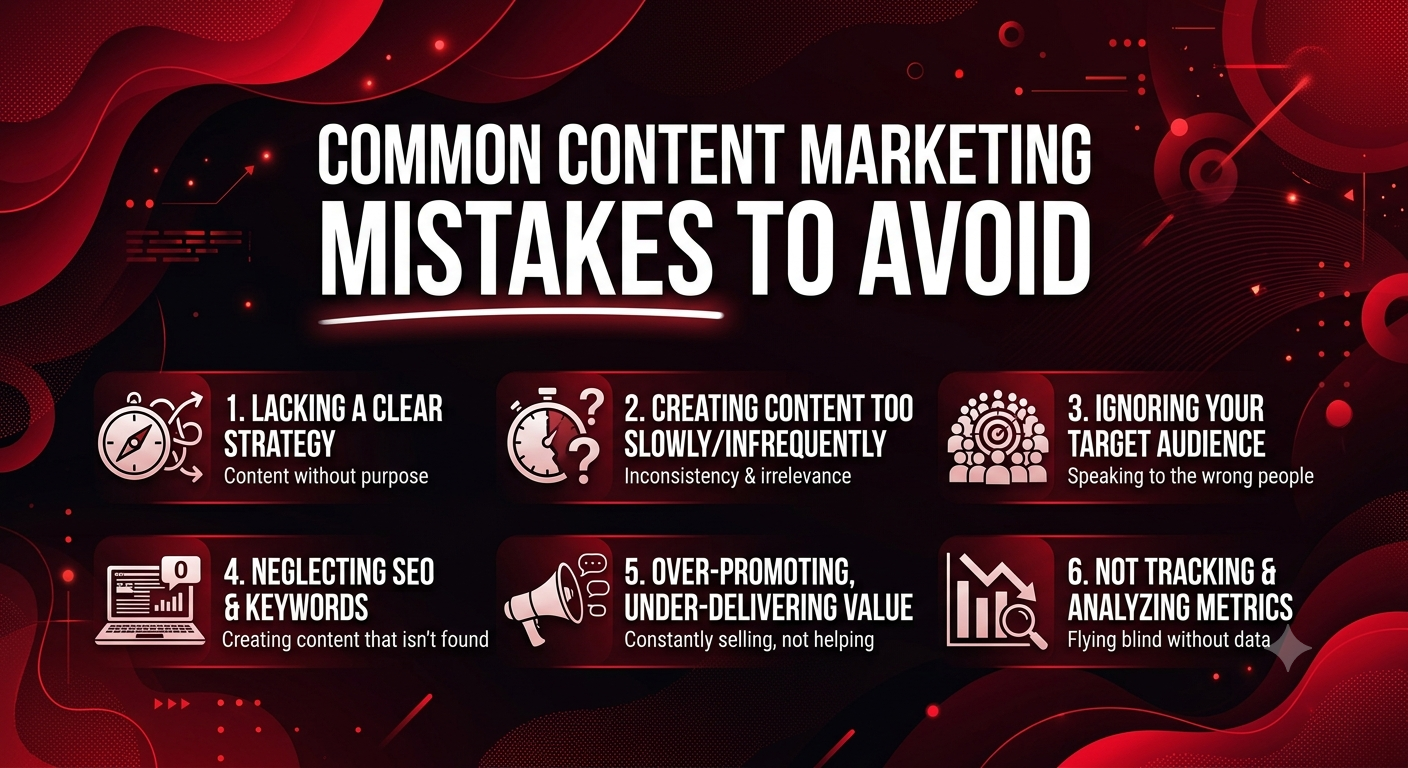
Even a good strategy can fail if you make common mistakes.
Creating Content Without a Goal
Every piece of content should have a purpose.
Before publishing, ask yourself what you want the reader to learn or do.
Focusing Only on Keywords
Keywords are useful, but content should primarily be created for people.
Avoid unnatural keyword stuffing.
Publishing Inconsistently
Publishing one article and then disappearing for several months makes it difficult to build momentum.
Choose a realistic schedule and follow it consistently.
Ignoring Existing Content
You don’t always need to create something new.
Older content can often be improved by updating information, adding examples, improving structure, and strengthening internal links.
Not Promoting Content
A great article may receive little attention if nobody knows it exists.
Promotion should be part of your content strategy.
Content Marketing Trends to Watch
Content marketing continues to evolve as technology and user behavior change.
Some important areas to watch include:
Short-Form Video
Short videos are increasingly useful for attracting attention and communicating information quickly.
AI-Assisted Content Creation
AI tools can help marketers brainstorm topics, create outlines, analyze information, and improve workflows. However, human expertise, originality, accuracy, and editorial judgment remain important.
Personalized Content
Audiences increasingly expect content that is relevant to their interests and needs.
Interactive Content
Quizzes, calculators, polls, interactive guides, and other engaging formats can encourage users to spend more time interacting with a brand.
First-Hand Expertise
Content that demonstrates genuine experience, practical knowledge, original examples, and useful insights can stand out from generic information.
Final Thoughts
Content marketing is not about publishing as much content as possible. It is about creating the right content for the right audience at the right time.
The most effective content marketing strategies begin with understanding your audience, researching relevant topics, creating valuable content, optimizing it for search, promoting it across suitable channels, and measuring the results.
Start with a simple strategy. Choose a specific audience, identify their biggest problems, create useful content that answers their questions, and publish consistently.
Over time, your content library can become one of your most valuable digital marketing assets. It can attract new visitors, build trust, generate leads, strengthen your brand, and support long-term business growth.
The key is consistency. Don’t expect content marketing to produce overnight results. Focus on providing genuine value, learn from your performance data, improve your content regularly, and continue building a relationship with your audience.
Frequently Asked Questions
What is the most effective content marketing strategy?
There is no single strategy that works for every business. A strong approach usually combines audience research, SEO, valuable content creation, content promotion, email marketing, and performance measurement.
How often should I publish content?
The ideal frequency depends on your resources and audience. It is generally better to publish high-quality content consistently than to publish large amounts of low-quality content.
Is content marketing useful for small businesses?
Yes. Small businesses can use content marketing to answer customer questions, improve online visibility, demonstrate expertise, and build relationships with potential customers.
Does content marketing help SEO?
Yes. High-quality content can support SEO by targeting relevant topics, answering search queries, attracting links and engagement, and creating opportunities for internal linking.
How long does content marketing take to produce results?
Results vary depending on the industry, competition, content quality, website authority, and promotion strategy. Content marketing is generally a long-term strategy rather than a quick marketing tactic.
What types of content should a business create?
Businesses can create blog posts, videos, social media content, email newsletters, guides, case studies, infographics, webinars, and other formats. The best formats depend on the target audience and marketing goals.
Focus Keyword: Content Marketing Strategies
SEO Title: Content Marketing Strategies: Complete Guide 2026
Meta Description: Learn the best content marketing strategies to attract your audience, improve SEO, generate leads, build trust, and grow your business online.
Permalink: /content-marketing-strategies/
Suggested Tags: Content Marketing, Digital Marketing, SEO, Content Strategy, Online Marketing, Marketing Strategy, Content Creation, Lead Generation, Brand Awareness